
Many teams expect each page to stand on its own. They publish a strong article, refine it, and wait for it to rank or appear as an answer. Sometimes that works. In answer-driven systems, results depend on more than a single page.
Answer engines evaluate the site behind the page.
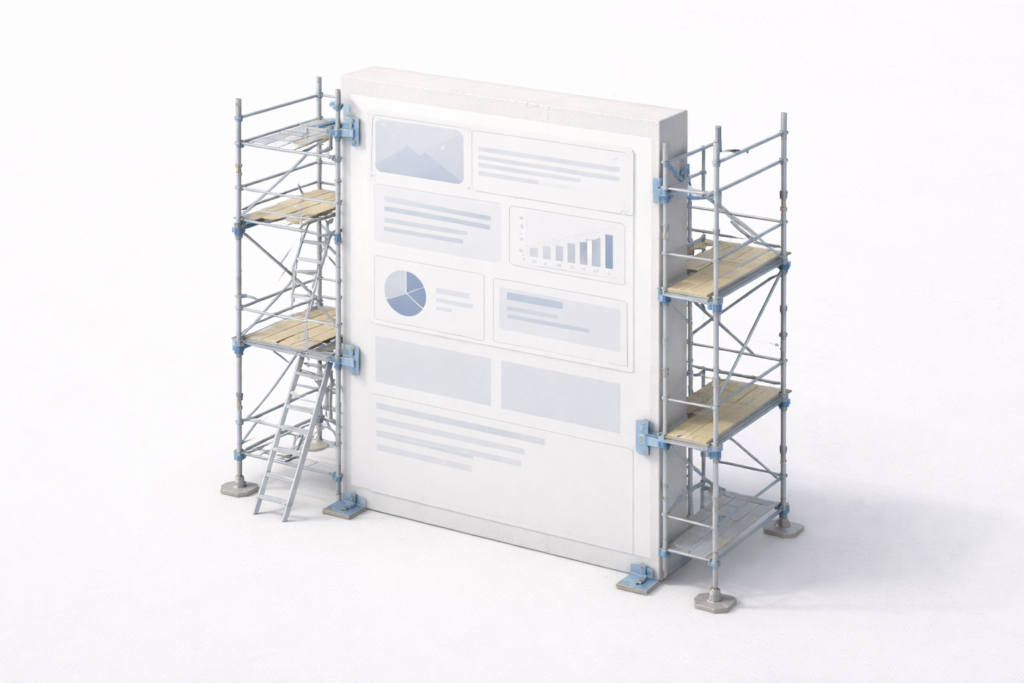
When a page appears isolated, systems have less context for judging reliability. When that page sits within a network of related content, the same information becomes safer to reuse. Supporting content provides that context.
What supporting content means
Supporting content is the collection of pages that reinforce your main topics. It often includes:
- Deeper explanations of subtopics
- Definitions and clarifications
- Related questions users commonly ask
- Examples, comparisons, and edge cases
- Internal pages that use consistent terms
This material shows that the site understands the topic beyond one surface explanation.
Why answer engines look beyond a single page
Answer systems manage risk. When they quote or summarize content, they take responsibility for accuracy and clarity. To reduce uncertainty, they look for signs that a source is stable and well informed.
Those signs often come from the site as a whole:
- Consistent coverage of a topic
- Explanations from more than one angle
- Internal pages that support each other
- Clear grouping around a main subject
A strong page can be overlooked when the surrounding site offers little evidence of depth.
How internal links support answer visibility
Internal links help systems interpret structure. When links follow a clear pattern, they show how ideas relate.
A well-linked site communicates:
- Which page represents the main topic
- Which pages add detail or answer follow-up questions
- Where definitions and explanations live
- How sections connect into a larger whole
This structure reduces uncertainty. Systems can see how a pulled paragraph fits into a broader explanation and where to look for confirmation or expansion.
Supporting content turns individual pages into a visible knowledge structure.
When good pages still don’t get selected
A common situation appears when a page reads well and covers the topic accurately, yet never shows up as an answer. In many cases, the missing signal is supporting content.
Without surrounding context, the system sees a single page rather than a dependable source. Supporting pages change that perception by showing coverage and consistency.
The AEO takeaway
Consistent answer visibility comes from building around topics, not isolated pages. A strong site typically includes:
- A clear pillar page for each main topic
- Supporting pages that address related questions
- Internal links that connect everything into a readable structure
Answer engines evaluate sources, not isolated pages. Supporting content is how a site presents itself as one.
See how supporting content and internal ecosystems strengthen answer visibility over time.